


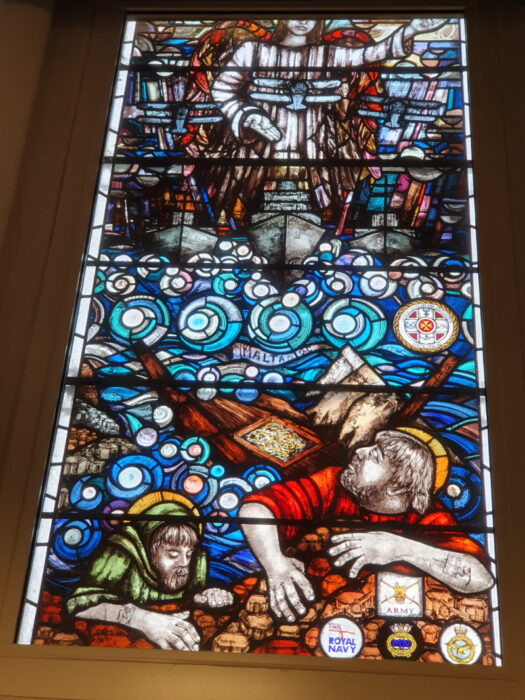
15th February 2026. It was thanks to a knowledgeable friend that I learnt this week about one of Tyneside’s best-kept secrets, the George Cross stained-glass window in Newcastle’s ‘Black Church’, the church of St Thomas the Martyr, next to the town’s Civic Centre.
The church itself is dedicated to one of the most famous martyrs in England, St Thomas Beckett, Archbishop of Canterbury, who was murdered in 1170 by a group of four English knights acting – so they believed – on the orders of King Henry II. It sits above an ancient chapel said to have been built by one of St Thomas’ assassins, Hugh de Morville, Lord of Westmorland.

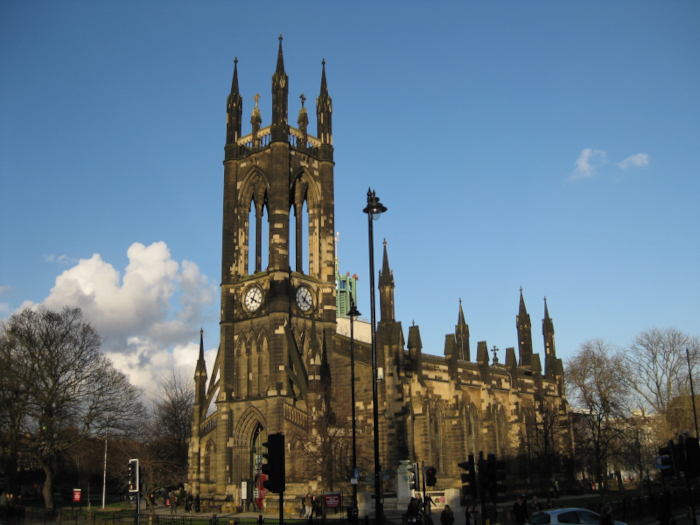
Why the ‘Black Church’? Nothing supernatural or heretical here. Although some might point out its link to the assassination of a prominent English churchman, the story is really one of the building’s external appearance, the result of a century or more of heavy industry on Tyneside during the industrial revolution.
WWII Siege of Malta
But it is the little-known George Cross window that intrigued me. Situated in a small alcove, it is a fairly modern stained-glass window commemorating the George Cross decoration awarded to the island of Malta by King George VI on 15th April 1942.
The Siege of Malta during the Second World War marked an important point in the conflict, which away from the home front was marked by an unendng series of military failures and disasters. Europe was almost completely overrun by Nazi Germany, British forces in North Africa had been pushed eastwards almost to the borders of Egypt, and the fall of the (thought impregnable) fortress of Singapore to the Japanese in February 1942 brought the surrender of some 90,000 Allied troops.
The news was unremittingly grim. Morale in Britain was probably at its lowest point in the whole war. In the Mediterranean, Malta was the last surviving naval base between Gibraltar and Egypt still withstanding Nazi power.
Malta’s position in mid-Mediterranean gave it a key strategic position astride supply routes between Italy and German army units fighting in North Africa. And the island’s main harbour, Valletta, was an important base for the Royal Navy. Unsurprisingly, the port was a key target.
Italian and German aircraft in Sicily were just 60 miles away from Malta. From 1940, two years of air attacks had made the island’s situation critical – by the middle of 1942 the defence forces were on their last legs, and the population was starving.
Lowest point of the war
The George Cross window in St Thomas the Martyr church commemorates this critical period in the war. The window is dedicated to all those who came to the aid of the island and its people during this time.
Details in the design for example illustrate the legend of the three Gloster Gladiator biplanes ‘Faith’, ‘Hope’ and ‘Charity’, which were all the air defence that local volunteer pilots could offer at the outbreak of hostilities in June 1940. Although the three Gladiators were really six aircraft used interchangeably, their easily recognisable shape as WW1-era biplanes gave them a somewhat heroic air, and caused the islanders to name them accordingly.

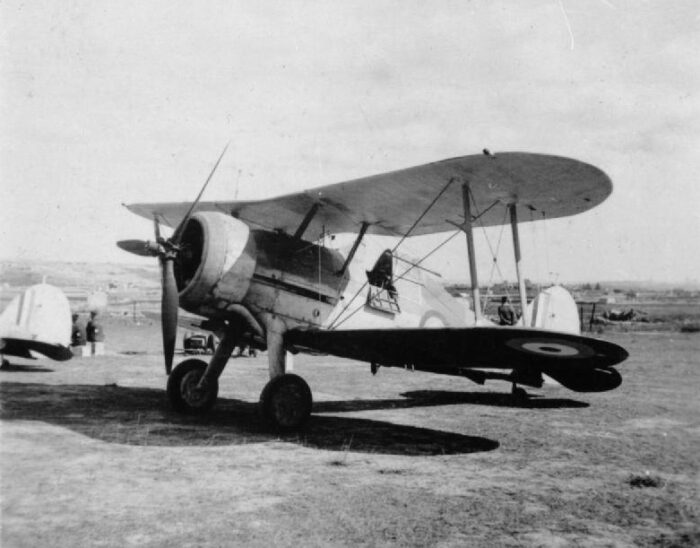
But after that initial stand, the island quickly became almost defenceless from the air, and Axis aircraft had free range to attack any targets they chose. Supply by sea quickly became near impossible; ships came under heavy air attack as soon as they passed Gibraltar.
By August 1942 food and fuel supplies on Malta were exhausted – the island was within weeks of surrender to the Axis. Following so shortly after the disaster of Singapore, Prime Minister Winston Churchill decided that Malta was an island fortress that had to be saved.
The Royal Navy assembled the largest fleet it had ever committed to a convoy operation. In Operation Pedestal, some 36 warships were tasked with escorting just 14 merchantmen to the island. As expected, hundreds of German and Italian aircraft, submarines and small attack boats (E-boats), all operating at close range from the Italian coast, converged upon the convoy and made determined attempts to sink the supply ships.

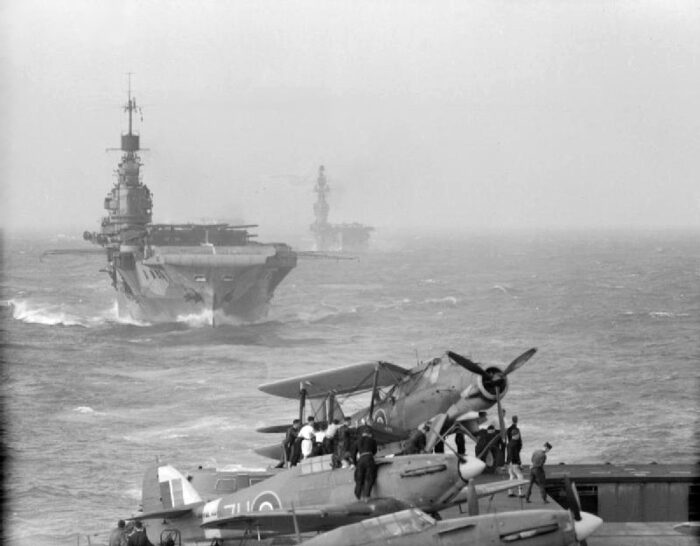
Those sea battles in the Mediterranean between the 11th and 15th August were some of the most intense of the war, involving four aircraft-carriers, two battleships, seven cruisers, scores of destroyers and smaller craft. More than 500 sailors and airmen were killed in that one convoy, nine merchant ships were sunk or abandoned, and only five of the original fourteen merchantmen reached Malta’s Valletta harbour.
Story of the SS Ohio
The inspiring story of one of the most important ships in that convoy, the SS Ohio, a British-crewed American oil tanker, has been the subject of numerous books and documentaries. The ship, as one of the newest and fastest tankers afloat, was leant by the United States expressly to assist in the convoys to Malta.

‘Assistant steward Ray Morton, aged eighteen, was dispatched to the Ohio on Clydeside by the Newcastle Seamens Pool, with a pay increase to £14 a month and a £4 “War Risk” supplement. Having experienced three years of rationing, and after sailing in a succession of rust-buckets since he started sea-faring life as a cabin-boy, he was awed by the comparative luxury of the American vessel. She had been provisioned in the USA and had grapefruit in the cool-rooms, a dozen varieties of cereal for breakfast, followed by bacon and eggs!’ (Max Hastings, Operation Pedestal).
As the largest and most obvious ship in the convoy, the Ohio was attacked repeatedly in attempts to sink it. The tanker was damaged so badly in successive waves of attacks that her captain was eventually forced to abandon ship in mid-Mediterranean. However for some reason she did not sink, so captain and a volunteer crew returned on board and attempted to make repairs.
With the Ohio too badly damaged to make way, the Royal Navy strapped a destroyer to one side in an attempt to get her through to the island. As the bombing attacks continued and further damage sustained, the ship was at risk of breaking her back. A second naval destroyer was then lashed to the opposite side of the tanker, and with these ships providing buoyancy and motive power, the Ohio finally limped into the port of Valletta, delivering 10,000 tons of badly needed oil fuel.
The arrival of five merchant ships in Valetta harbour was a vital boost for the island and its people. But the arrival of the Ohio was hugely symbolic – her cargo of aviation fuel enabled the island fortress not only to survive, but also to recommence its air offensive against Axis shipping.

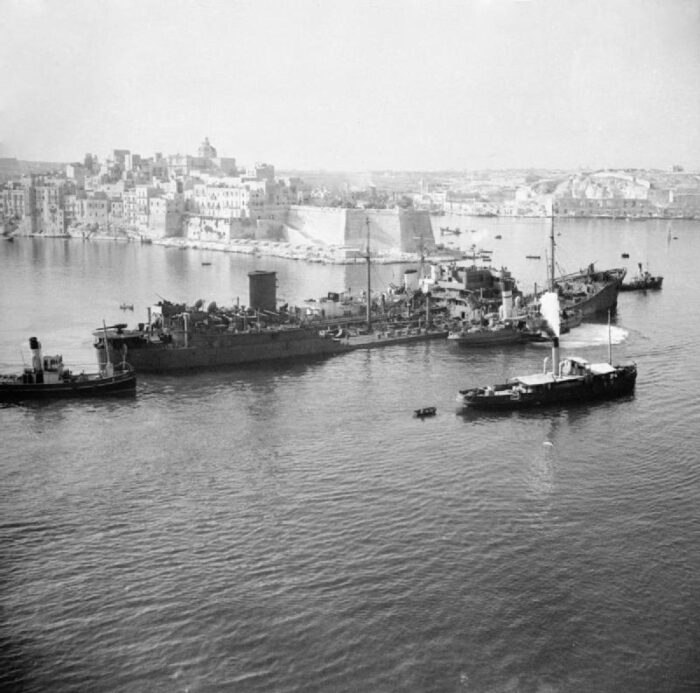
Photographs of the Ohio limping into harbour are telling – the extent of the damage she received can clearly be seen, and can bring a tear to many a mariner’s eye. The story of the Ohio and her crew came to symbolise the sacrifice made by so many merchant sailors in resupplying Malta during this critical period in the war. It is part of the legend of the Siege, and is also marked in the detail of the church window.
Assistant Steward Ray Morton, whose shipboard role included manning an upper-deck anti-aircraft gun, never made it to Malta. He was blown overboard when the tanker was torpedoed, and listed as ‘missing presumed lost’ in the Mediterranean. Unbeknownst to the authorities however he had survived, being picked up by a destroyer and returned, somewhat singed, to Gibraltar. He eventually settled in Australia, and finally reached the island for a survivors’ re-union in 2002.
The George Cross window
Why is it known as the ‘George Cross’ window? The George Cross was awarded to Malta by King George VI on April 15, 1942, in recognition of the bravery of the island and its people during the intense bombing and siege they endured from German and Italian forces. The decoration was incorporated into the flag of Malta in 1943, and remained on the current design after the island gained independence in 1964.
North-East mariners’ involvement in the Siege
Tyneside and Wearside mariners, like so many in the British merchant navy, played a significant role in supplying Malta during the WW2 Siege of the island between June 1940 and November 1942. They manned the ships tasked with carrying essential goods including food, fuel and military supplies to the island. In doing so these seamen faced extreme danger, including attacks from enemy aircraft, surface craft and submarines.
Many of those seamen would have been involved in the biggest and most important supply convoy to Malta in August 1942, Operation Pedestal. That operation was completed at great cost. Of the 14 merchant ships that passed the Straits of Gibraltar, just five made it to Malta.
The casualty rate for merchant seamen during WWII was often high, averaging around 25%. But in that one voyage, some 500 sailors and servicemen lost their lives. The extent of those losses is also marked in the church window.
© Philip Hunt 2026
More information
Operation Pedestal, by Max Hastings, tells the remarkable story of the most important convoy to Malta in WWII.
On this day – BBC story on the day the island of Malta was awarded the George Cross
http://news.bbc.co.uk/onthisday/hi/dates/stories/april/15/newsid_3530000/3530301.stm
Raymond Morton’s story of his voyage to Malta on the SS Ohio as part of Operation Pedestal.