


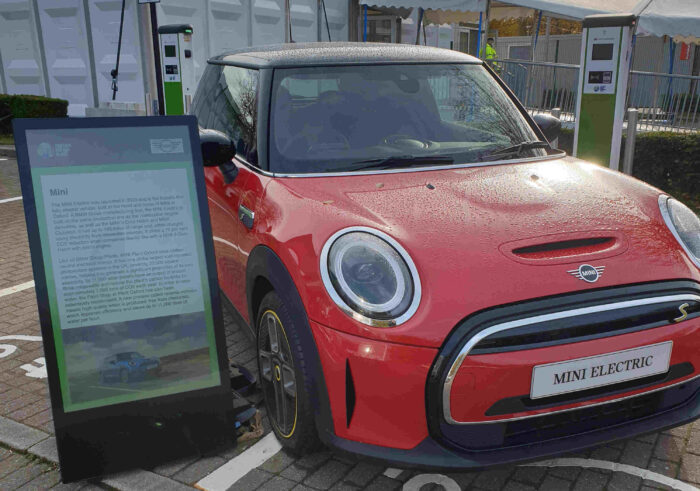
04/07/2022. Updated: China is racing to electrify its future In a Wired piece, China claims to be massively investing in its EV infrastructure, including battery-swapping as an alternative to charging on the go. Interesting that Tesla has rejected battery-swapping – I’m guessing due to the need for overstocking of spare batteries at multiple locations, and the consequent potential for waste (not to mention the need to dispose of toxic materials).
26/01/2022. Updated: The hidden costs of charging an electric car at home. An excellent piece from the Daily Telegraph explaining why EV buyers concerned about charging availability are likely to be caught in the gap between national policy and local government provision.
26/01/2022. Updated: UK electric vehicle charging network is lagging behind, says Volkswagen. See also this piece from the Guardian pointing out that the UK’s charging infrastructure (or lack of it) is what is holding sales of EVs back. Interesting to see both these newspapers (opposite ends of the political spectrum) pushing the same argument!
EV infrastructure – some joined-up thinking required
07/12/2021. The National Grid and Sainsbury’s were two strategic partners with stands in the Green Zone at COP26. You might think them an unlikely pairing within one article, but I had the same question for each of them.
Much of the hype around 2030 assumes that electric vehicles (EVs) will be the default method of personal transport in the future, i.e. most of the vehicles on the road will be electric. That is assuming that many people will still want to retain some means of private transport.
This being so, what preparations are the National Grid and Sainsbury’s (as a typical large British supermarket) making for that future. After all, we are looking at no new ICE (internal combustion engine) cars being sold after that date, with some manufacturers (e.g. Volvo) cutting off much sooner.
My understanding is that the average lifetime of a modern car is about 14 years. Yet many consumers like to own a vehicle that is no more than about four or five years old. Owning such a vehicle for, say, 4-5 years, is reckoned to be the most economic way of owning your own car.
The 2040 scenario
Which gives us 2040 as the year by which large numbers of conventional vehicles are likely to be taken off the road. That is just 20 years from now.
I assume that, as the auto market also appears to believe, most private-car owners will want to retain a vehicle for their personal use after that time (a desire that, for better or worse, has proved remarkably resistant to green campaigners pushing alternatives).
Unless then we all become the most amazingly able motor mechanics, and leaving aside market blandishments to “go electric” before that time, in 2040 the roads should begin literally humming with electrically powered wheels.
However, all those personal “motors” will need charging every day. What is the National Grid doing to prepare for the likely increase in load on local distribution networks?
The nice people were happy to talk about interconnectors and the greening of the network, but had to admit that they dealt with high-tension wires only (the pylons). Electricity distribution further down the chain was the responsibility of the likes of Scottish and Southern (SSE). They couldn’t comment on the ability of local electricity suppliers to handle increased loads.
A shame, because I wanted to know about lampposts! All those streets of Victorian houses in northern English cities where the only parking is in the street, and sometimes on one side only.
Lampposts in such areas have been suggested as the means of providing EV charging to residents. But in my street, one of typical Victoriana, it is on most days difficult to find a parking place at all, let alone find a spot next to one of the three, yes just three, lampposts.
A possible alternative is the supermarket car park. It’s true I have a large supermarket a short walk away, but if we are to rely on spaces in such private car parks, then by 2040 supermarkets will have to provide car charging at every place, not just five or six special bays.
So I walked over to the Sainsbury’s stand and asked them the same question. They didn’t appear to understand, unfortunately. There was lots of nice material on the greening of the distribution chain, but apparently little thought given to the last link, how the customer gets his or her shopping home. Pretty obviously, no-one had given it a thought.
In my 2040 scenario so far, it seems we’re going to have numbers of electric cars humming around the neighbourhood every evening, with the majority of their owners in a state of extreme stress as they seek a charger to prevent their vehicle batteries reaching zero!
I exaggerate, of course. Yet clearly, any supermarkets with car parks in city locations will have an opportunity to sell EV charging to local residents. Indeed, it is quite possible that these car parks could be busier overnight than they are in the shopping day.
Some supermarkets could see this as an additional revenue opportunity. If so, more power to their elbow I say, as long as they use that additional income to cut their margins on food products.
Either way, whether good EV citizens like me have to rely on lamppost or car-park provision for charging, I’m not sure that local electricity distribution networks are quite up to scratch. If local electricity networks have to supply such loads every night in inner-city areas, the days of cheap overnight electricity are likely to be numbered.
I’d have loved to have found a solution to my 2040 dilemma. Unfortunately I ran out of time before talking to Scottish and Southern Electricity. It may be that there is an amazing new solution being developed as I write! But I haven’t heard. I’ll have to leave it to readers here to enlighten me.
© Philip Hunt 2021
—–
EV infrastructure – a business view
Update 07/12/2021. Subsequent to my COP26 visit, Scottish and Southern Electricity (SSEN) kindly sent me a report outlining their approach to an EV future. ‘SSEN – Accelerating a Green Recovery’ notes that:
By 2035 we can expect 35 million EVs on our roads (up from 200,000 in 2018) requiring 386,000 km of network line reinforcement, with up to 66% of this taking place underground in built-up areas across the UK.


Further: A ‘bottom-up’ approach to local network development should be adopted by putting in place Local Area Energy Plans (LAEPs). These plans are co-developed by network companies and local bodies with input from key stakeholders, including transport groups, consumer bodies and network users to collect data and evidence of need.
And: To accelerate the rollout of EV infrastructure the UK should encourage competitive tendering of an area-wide network of EV charge points, leveraging investment to deliver a universal service provision across the country. Tendering for an area-wide network of EV charge points will complement the rollout of ultra-rapid and ensure gaps on the secondary network are plugged.
SSEN says that it strongly advocates the expansion of Clean Air and Low Emission Zones, noting that income from such zones can be used to help fund EV infrastructure (if the Transport Act 2000 is amended to explicitly include the funding of EV charge points).
It also emphasises a need for common standards, so that EV drivers can pay for a common unit of charge without need of special apps or charge cards (in the same way as certain EU countries, the report notes).
V2G or Vehicle to Grid participation will be fundamental
One of the interesting points in the report was that EV owners will be expected (‘encouraged’) to offer their vehicles as a resource to help balance demand on the grid. Known as Vehicle to Grid or V2G technology, the idea is that owners will use their EV battery as communal charge resource for the grid when the vehicle is stood idle.
A great idea – though of course it assumes that those EVs will be stood in one place with their charging cables connected for lengthy periods of time, overnight say. Which doesn’t fit too well with other approaches I have heard to managing charging demand, namely that future EVs with greater battery capacity will not need recharging every day.
Such advanced electric vehicles may not need their batteries charged every day, but if V2G technology is to work then they will certainly need to stay connected to the charger, or the idea of a network of a shared battery resource does not stand up.
Which brings me back to my original point. By 2040, how are inner-city residents with EVs going to keep their vehicles charged? I still do not see how Victorian streets can be equipped with sufficient EV charge points to meet demand. It may simply come down to a typical British compromise, and pavements littered with charging cables especially overnight. Which is not exactly an encouragement to safety for pedestrians and the disabled.
Or it may be that those living in inner-city houses or apartments will not be able to maintain a vehicle at all! Perhaps the electric bike, the taxi or public transport will have to suffice.
This idea will no doubt make the Greenies amongst us happy, and may even be better for the planet. But it hardly adds to the idea of personal choice!
I’m afraid my doubts about how the 2040 scenario is going to play out remain. I wish the planners, the stakeholders and the various consultation bodies well in their attempts to deliver on the promises made at Paris, I really do. Certainly we need to make a serious attempt to reduce air pollution from traffic, and EVs are the likely solution.
But there remains, still, a need for some serious joined-up thinking if an EV future is to work.
© Philip Hunt 2021.
——
More information
AFP (fleet drivers association) mapping likely charger demand
Subsequent to my last piece, I see that one industry body, the Association of Fleet Professionals (AFP), plans to publish a street-by-street map of demand for EV kerbside charging in early 2022.
AFP is aiming to collate information gathered from around 160,000 potential and existing drivers. The map can then be used by national and local government, as well as charging and electricity suppliers, to see where the chargers are most needed.
The association has been gathering postcode data from organisations including Royal Mail, Centrica, OpenReach, ISS, DEFRA, Kier, Mitie, VM O2, Marston Holdings, Capita, National Grid, SSE, Speedy Hire, J Murphy and Clarion Housing.
Says AFP chair Paul Hollick, “It’s no exaggeration to say that the creation of the Kerbside Charging Group has created more interest than any other subject or campaign with which the AFP has become involved. Every day we are hearing from fleets, especially van fleets, that want to speed up the electrification of their operations, but are hampered by the problem of charging for drivers who do not have a drive or any other access to a charger.”
Hollick believes that this uncertainty applies to about 40% of drivers across all fleets. When it comes to small vans, the figure is nearer 70%. He says the association is keen to hear from other businesses that are not currently AFP members in order to have their views.
“Our plan is to be able to create a map early in the New Year that will show on a street-by-street basis where kerbside charging is required. This will be a crucial tool when it comes to making fleet electrification happen faster.”
AFP is holding a webinar on kerbside charging at 9am on Wednesday 15th December 2021. Anyone who would like to attend can now register through the AFP web site at https://www.theafp.co.uk/webinars.
Scottish and Southern Electricity (SSEN) – Accelerating a Green Recovery