

One first-timer’s impression of COP26
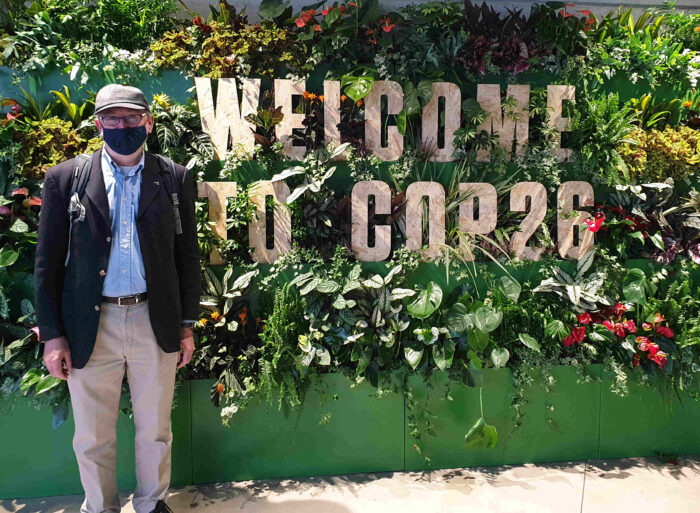
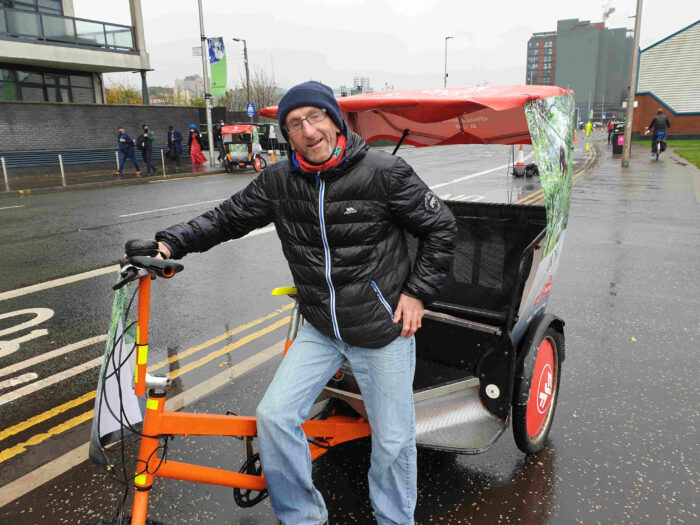
18/11/2021. I had this photo taken at #COP26. Lovely pic, isn’t it. Yours truly surrounded by flowers. Surely that is how a conference about climate and the environment should be!
Unfortunately, the photo gives a misleading impression. Much as I would have liked the COP26 climate conference to have included a plethora of healthy plants and flowers (what saving the planet is all about, surely), the reality was disappointing. The flowers were plastic, and the one attempt to create a real natural environment, by Sky0 in the Green Zone, was remarkable mainly for the row of dying trees.
While a veteran at EU conferences I’m a newcomer to the COP scene. And the lasting impression I took away with me was that it was much the same as all too many international conferences. A grand vision and mission statement, with the usual suspects (in this case presidents, prime ministers and assorted minions) flying in and pontificating to their friends during the event, then flying home again.
Even that hoary protest organisation Greenpeace was not immune to this kind of behaviour, indulging quite literally in showboating at Glasgow. The organisation sailed an ocean-going tug up the Clyde to deliver four, yes just 4, activists to the start of the conference. Headline grabbing it may have been, sustainable behaviour it was not.
Perhaps the main difference to other conferences I have attended was the sheer importance attached to the event by so many people around the world, as evidenced by the number of protesters and climate activists present. For two weeks, COP26 was the focus of the hopes and fears of anyone concerned about the global environment.

For climate activists and environmental campaigners, COP26 was hugely significant, carrying their hopes and dreams of real progress after, for some, years in the wilderness.
Governments and business saw it in a more matter-of-fact way. Like many such international conferences, COP on the surface was about negotiation and deal-making, connecting the science to national and international climate policy. Coming to agreement about the best ways of going forward.
Yet it was also much more. As with all such big events, the information distributed, the points of view exchanged, are likely to have a long-term impact on participants views in a way difficult to measure.
Who is to know what improvements may come in the future from the surprise announcement by India that it would, after all, work to end coal use by 2070? Or the sudden statement from China and the US, bitter rivals for global influence, that they could find common cause in working together on emissions reduction.
Such statements can have influence. Not simply on national and international policy, but in opening the way for sometimes quite minor actors in international-climate terms to develop new approaches to improving the environment.
I’m thinking for example of how rising sensitivity to air quality (or lack of it), not just in Beijing and Mexico City but in towns and cities across Europe, has driven research into new methods to improve it, an issue of fundamental importance for city inhabitants suffering from the effects of breathing poisonous and sometimes toxic smog.
And the surprising research result that, for all the high-tech air-cleaners that can be applied to the problem, the best air cleaner for city streets is the common or garden hedge! “Green Canyons” are, it seems, the weapon of choice for countering city traffic emissions.
How did it go?
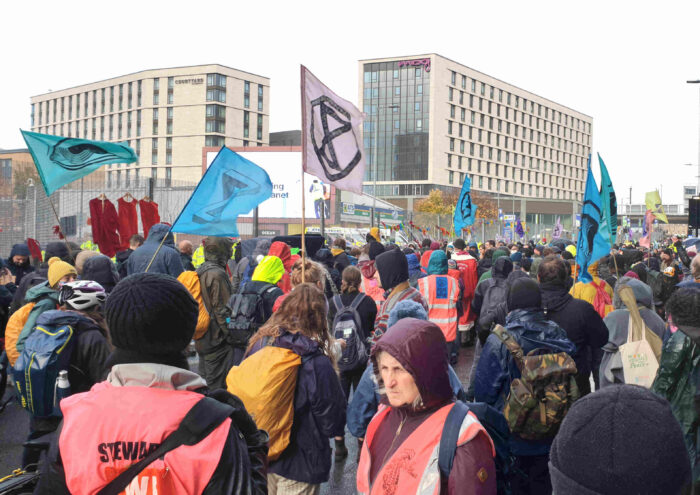
So how did COP26 go? At street level the event was an undoubted omnishambles. The usual activists and protestors (Extinction Rebellion or XR was strongly represented) crowded the entrance of course, and various assorted madheads (“CO2 is good for you”) also showed their faces from time to time.
More to the point, some security staff didn’t know where the various zones were, and others had no interest in helping. Glasgow’s police were out in numbers, yet on the whole I thought were remarkably polite and friendly considering the often cold and wet conditions, as well as having to cope with assorted PR ambushes specially contrived for the cameras.
COP26 organisation was not helped by official-looking signs for pedestrian and cycle access often pointing in totally the wrong direction. Indeed, I wondered if some people were deliberately trying to sabotage the event by putting them up in the wrong place.
Some memorable lines could be heard inside the conference and on the streets. “Keep 1.5 alive,” was perhaps my favourite, representing as it did the whole point of COP26. But there was also “unlock the talks”, “anyone not with us is against us,” and so many more.
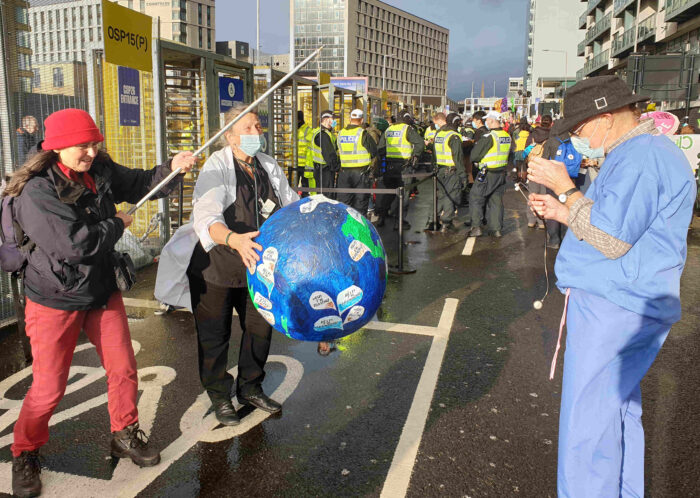
Of the various happenings, I appreciated XR’s organisation of a line of bodies covered in white sheets outside the conference entrance (people are dying). Another (by a small local activist group) which had a large suspended globe of the planet being diagnosed by a hospital medic, carried the sign “patient is running a high fever”.
Another memorable event should have been one thousand cyclists joining the march through Glasgow on Saturday, after cycling to the city from across the UK. Unfortunately I missed it.
Results a disappointment?
Several influential climate activists have stated their disappointment with the results of COP26. Indeed, Swedish campaigner Greta Thunberg said she considered the event as so much “bla bla” when it was only halfway through. While well-known columnist George Monbiot is reported as returning home on the train “outraged” in disappointment at the lack of progress.
Indeed, the measures that were actually agreed at COP26 are likely to leave some people cold. The last-day compromise forced by India and China on a coal “phase down” rather than a “phase out” was a huge disappointment, if not surprising.
Others believed that the world is still looking at a rise in global temperature of 2.7 degrees C compared to pre-industrial levels, as opposed to a safer 1.5 degrees. The representative for the Marshall Islands spoke in a particularly telling way about rising sea levels and the dire future for her country.
While in Africa, people will face a different kind of problem. The expanding cities in the north of the continent are dealing with water shortages already, thanks to mushrooming demand on underground water acquifers.
The unfortunate reality is that present levels of water consumption in Africa are unsustainable, as I wrote a few years ago here. It is quite likely that Nigeria’s largest conglomeration, the megacity that is Lagos with its population of 14.8 million, will be largely uninhabitable by 2050.
Overpopulation a taboo word
Yet despite the seriousness of the situation facing the planet, whether it is sea-level rise endangering low-lying areas or shortage of fresh water, no-one seems prepared to utter that taboo word – overpopulation.
It is quite clear that there are too many people in the world. The world probably passed the point of sustainability without artificial measures in the days of Queen Victoria. Even now, no-one wants to use the dread term.
I imagine that is because the subject makes most people feel deeply uncomfortable. How do you tell people younger than yourself (in my case that is most people) that there are too many of them?
No-one wants to be responsible for turning people against each other, or undermining the mental health of more sensitive individuals and introducing the risk of suicide. Who would want to do without the imagination and the sense of unlimited possibility that is the privilege of youth.
No-one, of course. And yet, and yet, how do we manage human population growth? The animal kingdom gives perfect examples of what happens when a species becomes too populous for its food resources. First individual animals go mad as social hierarchies break down, more and more conflict takes place over access to limited resources, and finally the whole species starves to death.
Is that our future? Are we really no more intelligent than the animals? The one society that made a noteworthy attempt to tackle the problem, China, was ultimately forced to abandon it. The people’s republic had to give up its “one child” policy due to the social distortions it caused.
Yet already driving decisions
Yet even in a so-called “stable” society like the UK, people are already making decisions about their future based on population pressure. One XR organiser I met admitted that she is moving her family out of the home counties and up to the Scottish west coast, because the south-east has become, she felt, over-developed to the point where quality of life has fallen.
I have to admit coming to a similar conclusion, moving away from my home town of Oxford to the north east, where I was once a student.
Why the move so far north? In my case I lived in continental Europe for 35 years. In one house just outside Brussels, I witnessed the changes to the soil and flora of a large and semi-wild garden over a period of 30 years. There was no doubt that this plot of heavy clay ground, once permanently damp, was drying out. And this in fertile Belgium.
Add a drying climate to rising air pollution, and I’m convinced that many people live in such polluted surroundings that they are unaware of it. And because the level of air pollution has risen gradually, they do not realise how bad things have become. I do not speak of the visible evidence of soot or the dust of diesel particulates on the windowsill, but the invisible killers of nitrogen dioxide or ozone.
In the worst parts of central London, young children have had to be taken to hospital with breathing difficulties, among them my own great niece. These are not the children of poor families, but from the middle classes living surrounded by very high levels of air pollution.
This evidence of changing climate, and the failure by successive governments to understand or address the problems of the overbuilt environment, are driving people to rethink what is important in their lives. Some, like me, have chosen to move. Newcastle upon Tyne has changed enormously since my student days in the early 1980s, but it remains (thankfully) a cold and windy city.
My decisions are those of just one individual, based on visible climate change in a temperate northern country. Imagine those kind of decisions being made by people en masse. We can see the results already on the channel borders.
So what can we do? My decisions have been at the micro-level – what about the macro? How can we save the planet? As one delegate at COP26 put it to me, “you can put solar panels on every house in the country, but it still won’t be enough to stay at 1.5”.
As many people at Glasgow made clear, some pretty drastic actions are needed if our society, perhaps even civilisation at all, is to survive. Greenpeace has said before that really the world should give up flying, yet few are ready yet to take such a huge step.
Some real achievements
So was COP26 a total waste of time? Regardless of the naysayers, I believe COP26 was marked by some important achievements. Even if they are not completely fulfilled in reality, they nevertheless move people and planet in a direction of greater safety.
I’m thinking of the major banks in the world agreeing to the ex-governor of the Bank of England Mark Carney’s ‘Glasgow Financial Alliance for Net Zero’, to secure $130 trillion in private capital to fund the transition to net zero.

Also of the announcement by Indian Prime Minster Narendra Modi, that his country will renounce use of coal by 2070. This was not the hoped-for deadline of 2050, but still, for the country that is the biggest user of coal in the world, where for some regions coal mining is still the major, perhaps the only, employer, this was a clear statement of intent.
And while much disappointment has been expressed at the “phase down” rather than “phase out” from India and China about use of coal by 2050, the compromise is almost certainly a reflection of achievable reality rather than impossible dream.
So … COP a waste of time?
So was COP26 a waste of time? No, it was not, I believe. It may have been flawed, and the results imperfect. But I asked this same question of many attendees both inside the conference and the on the streets, and the replies came back much the same.
COP26 was imperfect, and “we didn’t get all the results we hoped for from such a globally important conference”. As one seasoned XR campaigner put it after pondering the question at length, “COP26 may not have been the success we hoped for, but it’s still better than if we’d had no COP at all.”
© Philip Hunt 2021.
—-
Innovation at COP26
Behind the attention-grabbing conference headlines and street protests, the COP26 Green Zone showed that UK organisations large and small are toiling away in the background to develop more environmentally friendly alternatives for everyday needs.
I visited a few of them …..
COP26 Green Zone – what’s happening on the ground
GZ1 – That big red bus – fully electric or hydrogen?
GZ2 – tbc
GZ3 – tbc
Back to main story
—–
GZ1
That big red bus – fully electric or hydrogen?
It was sobering to find that the electric v hydrogen wars that powered so much lobbying during my time in Brussels continue still. Except that now we’re into practical, on-the-ground competition between rival suppliers of the traditional British double-decker bus.
At COP26 two of the big beasts from rival companies were on display. Except that one of them was painted green, the hydrogen powered Hydroliner from Wightbus in Ballymena, Northern Ireland.
The Hydroliner boasts six hydrogen fuel tanks at the rear, a fuel cell for power and range of around 300 miles. Although the present company only started up in 2019, the first versions are already being piloted on bus routes in London and Aberdeen.
The rival fully electric bus from Hinduja Group manufacturer Switch Mobility was positioned in the next parking bay. The Metrodecker holds up to 99 passengers and has a range of up to 150 miles. Somewhat less expensive to buy than its competitor, the bus is already in service in York and parts of London.
Switch Mobility representatives acknowledged the difference in range, but were at pains to emphasise that the Metrodecker falls within the old standard 18 ton weight limit for these vehicles, unlike the 19 ton weight of their hydrogen competitor. As they put it, heavier vehicles place even more load on already stressed city road substrates, especially in the braking zones on the approach to bus stops.
In any case, they emphasised, the range is more than sufficient for most inner city routes, bearing in mind intermediate charging capability at the turnaround points.
These were just two examples of the kind of green-power technology developing for these bus types. New models from other companies are likely to appear in 2022.
Glasgow also boasted what was claimed to be the UK’s largest working EV (electric vehicle) charging station. The First Bus depot in Cathcart Road is a working bus depot that is part of a partnership with Hitachi Europe. The depot is already operating, and First Bus has ordered 148 electric buses from Hitachi for delivery over the next 18 months.
First Bus and Hitachi also plan to develop solar panels and battery energy storage solutions for the site, with the potential that the site could soon be generating and consuming its own electricity as well as delivering zero-carbon charging hubs for other business fleet users.
More information
Hydroliner from Wrightbus
https://wright-bus.com/en-gb/meet-the-revolutionary-hydroliner
Switch Mobility Metrodecker
https://www.switchmobility.tech/en/current-vehicles
First Bus and Hitachi Europe
https://www.sustainable-bus.com/news/first-bus-hitachi-decarbonization-bus-depot-glasgow/
——
More information
Energy & Climate Intelligence Unit (ECIU): https://eciu.net/
Mark Carney’s ‘Glasgow Financial Alliance for Net Zero’: https://www.bloomberg.com/news/articles/2021-11-02/carney-s-climate-alliance-crests-130-trillion-as-pledges-soar
