

A fourteen century old question that has relevance today
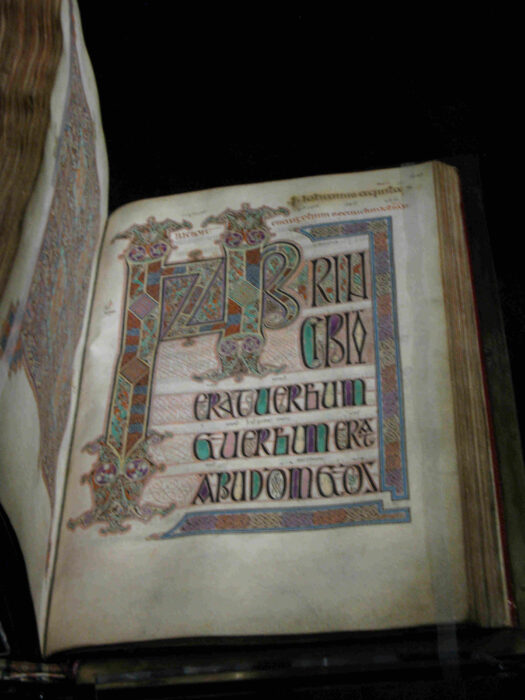
On display, the Lindisfarne Gospels at the Laing Art Gallery, Newcastle upon Tyne, until 2nd December 2022. Over a thousand years old, the central items at the exhibition are quite few, yet they have enormous power. And the framing of the exhibits has a meaning that still has resonance today.
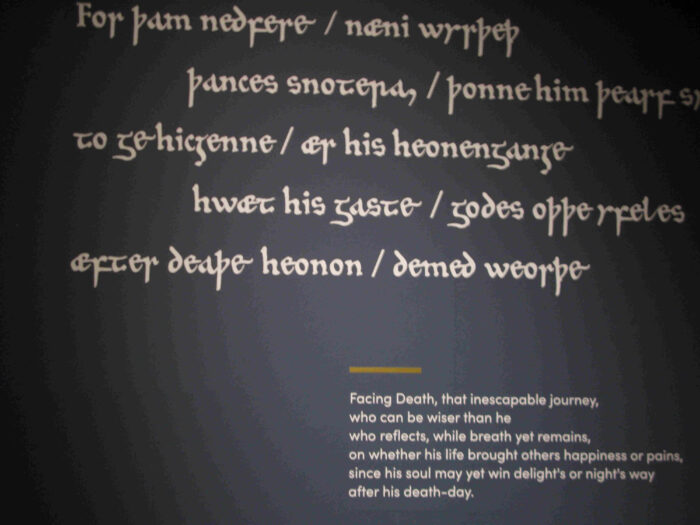
I’m talking of Bede, or the Venerable Bede, the eminent recorder of the annals of Anglo-Saxon England. And it is his Death Song, or the poem claimed to be the last thing he wrote on his deathbed that I find so powerful.
‘Facing Death, that inescapable journey,
who can be wiser than he
who reflects, while breath yet remains,
on whether his life brought others happiness or pains,
since his soul may yet win delights or night’s way
after his death-day.’
(Bede’s Death Song, West Saxon version, 12th century)
Bede passed away at that centre of Anglo-Saxon learning, the Monastery of Monkwearmouth – Jarrow, in 735 AD at the age of 63, a good age for the time. His poem represents to me what seems the age-old question of the human condition – does, or did, my life have meaning?
How many during this period of the Dark Ages had the luxury of time and the ability for reflection? Probably very few, and those mostly living and working in the monastic foundations. Yet Bede’s life and writings were valued for centuries after his death. According to the British Library, Bede’s Death Song, written in Old English, can be found in more medieval manuscripts than any other poem.
The ultimate personal inquiry
It is this ultimate question that frames the setting for the Laing Art Gallery’s display. Perhaps it is fitting then that the artefacts on display are few, and the setting minimalist.
The exhibits include the priceless original Lindisfarne Gospels manuscript loaned by the British Library, dating from around 700 AD and one of the earliest written records known. Also on display is St Cuthbert’s personal copy of the St John Gospel, thought to have been placed in his tomb shortly after the saint’s death in 687 AD and valued at around £ 9 million when it was bought by the British Library in 2012.
The sheer significance of these objects is hard to explain. That the Lindisfarne Gospels manuscript has survived some 14 centuries is itself a marvel. As relevant is its significance as a written cultural record, one of the earliest, from a time when England was undergoing a six-century long transition from a Celtic oral tradition to a Saxon written culture, one which was itself in the process of absorbing a continental European Christianity.
A time, then, of huge change. From a period of chaos to gradual acceptance of a new ruling culture – that of the Anglo-Saxons. Yet what has come down to us from Bede over a thousand years later, is a kind of universal truth – one that is timeless.
It is that – should not each of us take a moment to ask if our choices in life have been of value to others, as well as to ourselves. Have we brought joy, or pain, to those around us, family, friends and even professional acquaintances.
The Dark Ages – outlawry, migration and strife
It seems little short of incredible that such a question into the human condition was written at a time when the country, this place we call England, was suffering the Dark Ages. The last of the Romans had left in 410 AD, and it would be the 700-800s before the various Saxon kingdoms became well enough established to provide a semblance of law and order.
Civilised thought and behaviour would have been little in evidence outside of a few civic centres at the time. The six centuries between the departure of the Romans and the Norman invasion of 1066 were not particularly peaceful. In fact they were almost certainly terrifying for the ordinary townsman and villager.
Outlawry was probably endemic, with constant raiding between one village and the next. Fear of horsemen on the horizon bringing sudden death would have been commonplace, and those working in the fields had little power to do anything other than accept their lot.
Life then would have been nasty, brutish and short. Perhaps it is not so surprising that, in such conditions, prayer to the gods for protection or deliverance from misfortune would have assumed great importance.
The land at this time was open, ripe for invasion. No central government remained to provide stability or keep control, no central military power existed to deter raiders.
And so they came, in smaller groups at first then ever larger numbers. The Angles, the Saxons and the Jutes – Germanic tribes under pressure themselves from growing immigration to the east. They arrived, found fertile agricultural land ripe for the plough, and with little opposition, settled.
There would have been tension between the original British, the Celts, the Romanised inhabitants and the newcomers. One village could easily be set against the next. Only the safety offered by town walls and identification with a local warlord or strongman would have provided any kind of security.
Little consensus has been reached on the number of migrants who entered Britain in this period. Scholars have argued over figures varying from 20,0000 to 200,0000 people, yet computer simulations reckon that a quarter of a million could easily have arrived from mainland Europe over a half century, or even less. Spread that possibility over several centuries, and the incoming migration would have been substantial.
Advent of Christianity and the Cult of St Cuthbert
Into this fragile and violent culture, into communities never more than one season away from starvation and death, arrived the early Christian missionaries. St Augustine was the first, landing on the Isle of Thanet in 597 AD. He was sent by Rome to convert, with the help of the local ruler, the Anglo-Saxon pagans of Kent to Christianity.
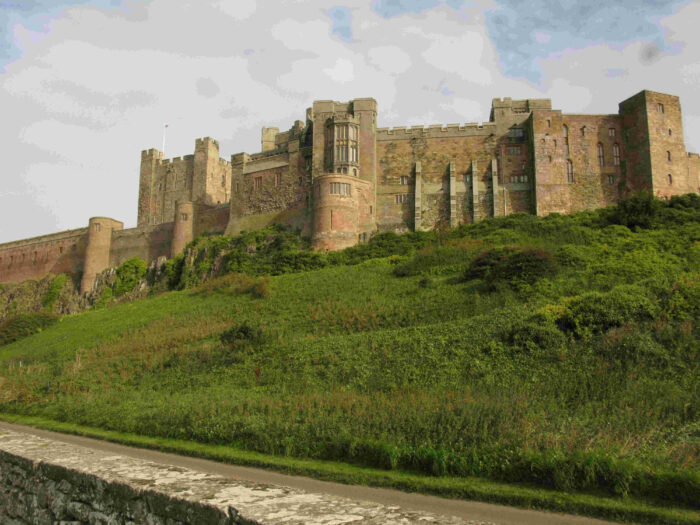
In Northumbria an Irish monk from Ionia, St Aidan, established a monastery on the isle of Lindisfarne in 635 AD. Here he was close to his patron King Oswald, in the fortress at Bamburgh. Oswald himself had first encountered Christianity in Scotland, and saw it as a means of uniting the fractious tribes that made up his native Northumbria.
St Aidan achieved great success in spreading the Christian faith (not surprising with the king as his patron), and Lindisfarne monastery became highly influential. And so a certain monk, Cuthbert, arrived from Melrose priory in 664/665 AD to study at the monastery.
Cuthbert would go on to become abbot of the monastery, Bishop of Lindisfarne and eventually the patron saint of Northumbria. St Cuthbert was widely regarded as the holiest man of his generation. He died in 687 AD, leaving behind a legend of special powers and miraculous cures.
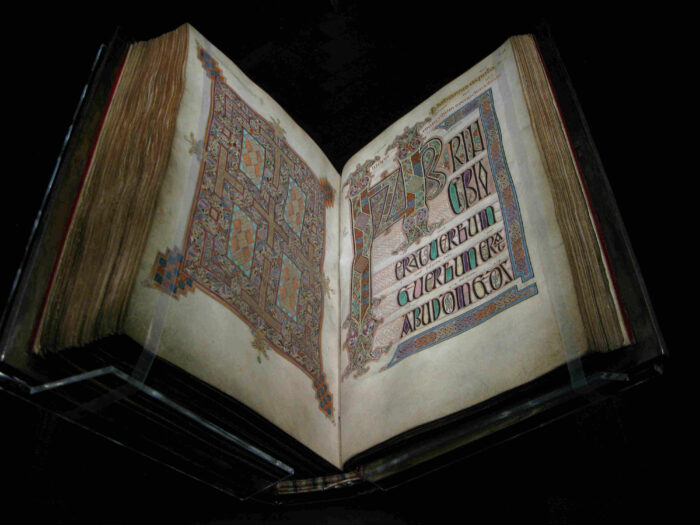
The Lindisfarne Gospels manuscript is associated with the Cult of St Cuthbert. Believed to be the work of a later bishop of Lindisfarne, Eadfrith, it dates from 715 AD. Richly illustrated, the book was originally bound in a fine leather cover incorporating metal and jewels (since lost in Viking raids). It is considered to be the finest and the most complete manuscript of the period produced in Britain.
Northumbria’s Golden Age
The Lindisfarne Gospels were written during what is considered Northumbria’s Golden Age, which lasted from the mid-seventh to the mid-eighth century. An Anglo-Saxon culture that embraced both Germanic and Roman influences, it stretched at the time from the city of York well into Scotland.
The Anglo-Saxon King Oswald of Northumbria (604 – 642) promoted the spread of Christianity as a way of uniting his two previously separate kingdoms of Bernicia and Deira. York became an important centre of learning under Northumbrian rule with the establishment of the library and the Minster school, and the city remained a royal and ecclesiastical centre for centuries.
Yet one of the most important works of the time was written at as written at St Peter’s monastery at Monkwearmouth-Jarrow. Bede’s Ecclesiastical History of the English People (written in Latin) describes the importance of Northumbria’s role in the country.
Bede set out his views on politics and religion (including my opener to this article) as well as telling the story of the English people. His work is considered one of the most important original references on Anglo-Saxon history, and key to the development of an English national identity.
Rise of the Vikings
Yet this developing English cultural identity faced terrifying competition. The Vikings had been raiding English coastlines for centuries, seeking loot and any valuables that were easy to steal away. Now they began to arrive in greater numbers. By this time Northumbria’s power had been eclipsed by the rise of southern Saxon kingdoms such as Wessex and Mercia.
The Viking ‘Great Heathen Army’ landed in 866 AD, took over the city of York and made it their headquarters. York subsequently became the centre of the Danish Kingdom of Jorvik, with large numbers of Danes arriving and settling.
Ironically, it was the very success of the Vikings in the 9th century in taking over large areas of the countryside (from the Scottish borders down to the Wash) that drove the various Anglo-Saxon kingdoms to think of themselves as sharing a common ‘English’ identity.
While associated at the start with the adoption of Christianity and the ‘One God’, this identity was reinforced by the threat from repeated Viking invasions. Christianity became a unifying influence, a common factor that enabled differing Anglo-Saxon kingdoms to find common cause in defeating the Viking foe.
‘How to be a good king’ – Alfred the Great
Perhaps the most successful practitioner of this ‘Christian unity’ approach was King Alfred (848 – 899 AD). Alfred spent years fighting invading Vikings, yet was forced to accept the division of the country into his own Anglo-Saxon kingdom in the south (Wessex), and the Danelaw ruled by the Vikings to the north and east.
Alfred was more than a capable military and administrative ruler. He saw religion and learning as important, and is credited with being largely responsible for the spread of writing skills throughout his kingdom, something quite unique in Europe at the time.
He came to power recognising that repeated Viking raids and invasions in the 860s had seriously damaged levels of knowledge and education. Numerous Anglo-Saxon manuscripts had been burnt along with the churches that housed them. Yet learning and literacy were, he believed, vital to the development of a modern and prosperous state.
Alfred, while supporting the church, promoted the use of English rather than Latin for matters of law and governance, thus reinforcing the powers of civic institutions rather than limiting them to the religious centres. The long-term aim of which was to broaden understanding of legal rules and principles among ordinary citizens.
Peace and the rule of law, he saw, were essential pre-requisites to the building of a prosperous nation-state. Tellingly he also understood, probably like several of his fellow Anglo-Saxon rulers, that replacing one set of savage gods with a single more powerful God was easier for the unlettered peasant to understand than more abstruse principles of law and civic duty.
Alfred’s achievement was to combine such ideas to build a power-base that would be unassailable by competitors, Saxon or Viking, and show the benefit in terms of greater production and greater prosperity. Not for nothing did he become known as Alfred the Great.
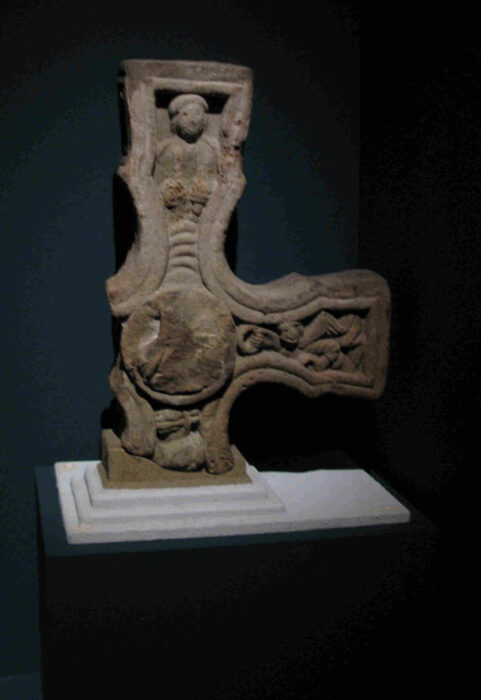
So Alfred’s support of the Christian church always had an element of self-interest. He recognised, like his churchmen, that reaching his objectives could be aided and abetted by promoting a shared Christian heritage. Hence the support from both church and state for native-born saints – men and women who could be said to embody the Christian ideal, the holy individual who was so profoundly loved by all around him that only miracles could follow in his or her wake.
This then was how the Cult of St Cuthbert could continue. With Christianity becoming deeply embedded within the developing ‘English’ culture, it wasn’t surprising that the Cult of Cuthbert could go from strength to strength.
Even the invading Normans in the 11th century were forced (with a little prompting from Rome) to recognise the cultural power of this saintly legacy. They simply took it over by unearthing St Cuthbert’s remains from his tomb and reburying them under a larger and more imposing Norman edifice (the present Durham Cathedral).
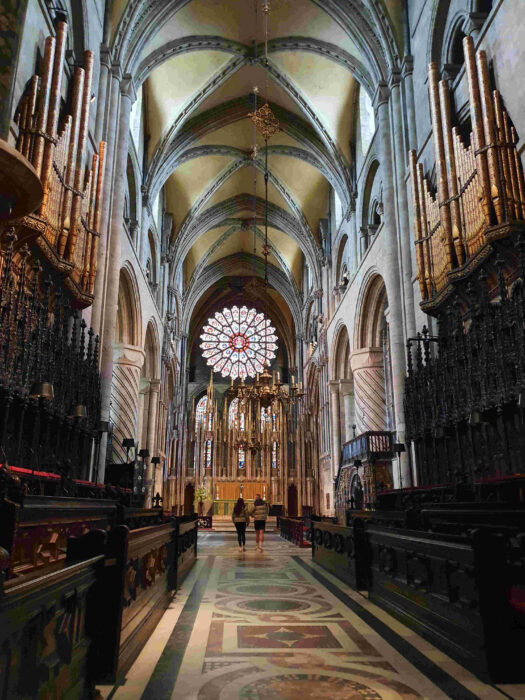
Which is why the St Cuthbert legacy has power still in the 21st century. The concept of the perfect individual, humble, faithful to his own and yet generous to others, filters down the generations to remain an example that is still admired today.
Yet what is the answer?
And it is why, also to this day, the concept of asking yourself the most important question of your life remains a profound one. The answer to the question ‘What is the meaning of my life?’
The answer is not 42, as some humourists in the recent past may have suggested (apologies to the Monty Python team). The answer is one that only each of us as individuals can answer, even if only in our most private thoughts.
Here today in the 21st century, when it seems that much of our lives has become all too public, this is maybe the only answer that will remain always honest, and perhaps for the same reason almost always private. But it is worth asking ourselves the question just the same.
© Philip Hunt 2022.
More information
Why was Bede named ‘the Venerable’?
In the Roman Catholic Church, ‘The venerable’ is the style used for a person who has been posthumously declared ‘heroic in virtue’ during the investigation and process leading to possible canonization as a saint. Before a person is considered to be venerable, he or she must be declared as such by a proclamation, approved by the pope, of having lived a life that was ‘heroic in virtue’ – the virtues being the Theological Virtues of faith, hope and charity and the Cardinal Virtues of prudence, justice, fortitude and temperance.
The next step is beatification, at which point the person is referred to as Blessed, and then finally canonisation, at which point the person is referred to as Saint. However Bede was declared to be ‘venerable’ soon after this death, and the name stuck.
Laing Art Gallery, Newcastle-upon-Tyne
Bede’s Ecclesiastical History of the English People
