


by Tony Morris
(This piece is originally an audio script written by Tony for a BBC Radio 3 podcast – you can access it via the link below).
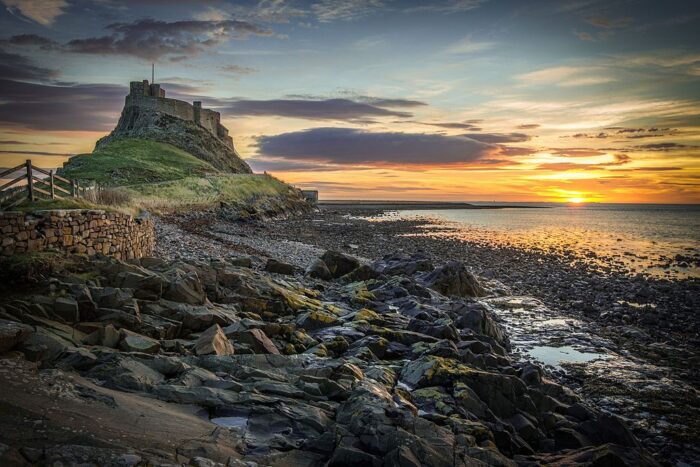
Lindisfarne – the Holy Isle. A place of pilgrimage, of sanctuary and of mystery.
As night descends and stars begin to spread out across the vast Northumbrian sky, you become more and more conscious of the wind in the dune-grasses, the cry of the kittiwakes, and the timeless washing of the waves on the shore.
And you begin to sense another presence. The spirit of Cuthbert of Lindisfarne. The greatest saint of Anglo-Saxon England.
Here are the ruins of the abbey where he was once Bishop. Here is where the famous Gospels were illuminated in his honour. Here is the cross, on the site of his simple hermitage.
Here are the bobbing eider ducks, the seabirds he loved so much, which, to this day, locals call ‘Cuddy’s ducks’ in his memory.
Here is the bronze statue of him, by the great Northumbrian sculptor Fenwick Lawson, facing out across the cold seas to the tiny, rocky isle where he spent the last year of his life. Alone.
And here is where he was laid to rest, in the year 687.
Pic.
An inspiration for Anglo-Saxon England
And this is where our story really takes off. For the most extraordinary thing about Saint Cuthbert is what he achieved after he died.
With every passing century he became more famous and more important. A cult figure. A symbol of Saxon virtue. The inspiration, first for a region, then for a whole nation. The greatest saint of his age. Destined to become the biggest pilgrimage draw until Thomas Becket half a millennium later. But not before he himself had gone on an extraordinary journey which was to last over 400 years and over 400 miles.
The story of his life – I should perhaps say lives – tells us much about the worlds we have lost – and maybe something about a world we need to regain.
The first account of Cuthbert’s life was written around 700 AD, by a brother monk from the Lindisfarne community. The writing style is plain and unadorned, but nothing can conceal the author’s admiration for his subject. For this is hagiography not biography. Life as exemplar not as precise historical record.
The story goes like this:
Cuthbert, a young shepherd, is tending his flocks on a Northumbrian hillside. One night he looks into the sky and sees a vision: ‘angels ascending and descending, (bearing up) to heaven a holy soul, as if in a globe of fire’.
Immediately Cuthbert awakens the other shepherds and describes the vision, prophesying further that it is ‘the soul of a most holy bishop or some other great person’. (Magnus Magnusson, Lindisfarne p.73)
Sure enough, it transpires that on that very night, which we can date as the 31st August 651, Saint Aidan had died. It was Saint Aidan who had been responsible for bringing Christianity from Columba’s holy island of Iona in the west, all the way across Scotland, to the North East coast of England. To Lindisfarne, where he had established a new holy isle, a new church community, a whole new centre of religious gravity.
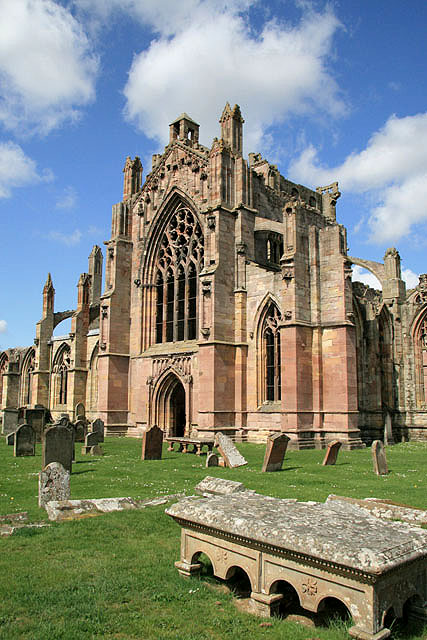
Inspired by this vision, Cuthbert leaves the hills and presents himself at the local monastery in Melrose. There he begins a lifetime of devotion and piety. Preaching, healing, ministering to the poor and sick, spreading the word of God, Cuthbert journeys the length and breadth of Northumbria, which in Saxon times stretched deep into what is now Scotland, as far as the Firth of Forth.
His training as a shepherd seems to have stood him in good stead, for he was able to reach villages described in the texts as ‘far away on steep and rugged mountains, which others dreaded to visit.’ Often he would not return for weeks on end, preferring to ‘tarry in the mountains, summoning the rustics to heavenly things by the words of his preaching as well as the example of his virtue.’ (p81).
One famous story tells of a monk who is curious about Cuthbert’s holy reputation, sceptical even. So he decides to follows him. From a secret vantage point he watches as Cuthbert leaves his monastery at the dead of night, scrambles down a jagged cliff path, then proceeds to wade out into the North Sea, waist-high into the freezing waters. There, under the moonlight, Cuthbert stands for hours, praying and singing psalms while the once-doubting monk looks on in awe.
What happens next is also typical of Cuthbert, for as day breaks and he emerges from the waves, reports tell how: ‘there followed in his footsteps two little sea otters humbly prostrating themselves on the earth; and, licking his feet, they rolled upon them, wiping them with their fur and warming them with their breath.’ (pp 82-3)
It’s one of many animal stories with which Cuthbert is associated: a sea-eagle who drops fish for him when he is hungry, a horse who shows him where to find sustenance, ravens who bring him gifts in their beaks …We are reminded of Saint Francis of Assisi – and that is the clear intention of the hagiographer…
Cuthbert’s compassion, his sincerity and simple piety, coupled with his energy and ascetic zeal, are recognized by all who meet him. His reputation grows.
People come from far and wide to be attended by him, Kings and Queens as well as the poor and the meek. He becomes something of a royal holy man. For Lindisfarne is close to the mighty citadel of Bamburgh, right at the heart of Northumbrian power.
Bishop of Lindisfarne
Eventually, in 685, aged 51, Cuthbert is prevailed upon to become Bishop of Lindisfarne. It is a role he neither seeks nor wants; but reluctantly he goes along with the request.
Cuthbert’s style of running Abbey business is very particular. When meetings become acrimonious, he simply stands up, and quietly leaves the Chapter house. He then removes himself to his solitary cell to pray, until he is informed that consensus has been reached. Whereupon he returns as if nothing has happened and calmly re-commences where he left off.
This is a tumultuous time in the life of the Church and many demands are made of the new Bishop. Demands which he dutifully takes on, but which he never really enjoys. For throughout his entire ministry, Cuthbert has yearned for a return to the solitary life of the simple monk shepherd. Like the desert fathers centuries earlier, he seeks to be alone, to commune directly with nature and with God.
First, he retreats to his cell on the southern tip of Lindisfarne. When this becomes too easy to visit, he sets out for an island known as the ‘Inner Farne’, a bleak basalt outcrop, surrounded by foaming waves, where seabirds abound but no humans live. Here, he builds a very rough shelter where, the records tell us, ‘he could see nothing but the heavens above.’ (p94)
And it is here, beneath the open Northumbrian skies, that Cuthbert dies on the 20th of March 687. He is fifty-three years old.
Read Part 2 – Saint Cuthbert of Lindisfarne
© Tony Morris 2022.
More information
Tony Morris is an Oxford (UK) based writer, blogger and historian.
