


The Venerable Bede – Cuthbert the embodiment of Anglo-Saxon Christian life
by Tony Morris
(Read Saint Cuthbert of Lindisfarne – Part 1 )
Next to write of the life of Cuthbert is Bede. The Venerable Bede. Scholar monk of Jarrow and one of the great minds of early Medieval Europe. Author of over 30 works, most famously the Ecclesiastical History of the English People (completed in the year 731).
It is without doubt his magnum opus. And no fewer than six chapters of it feature Cuthbert. Indeed, in Bede’s account of England’s christianisation, Cuthbert becomes the pivotal figure of the entire magisterial narrative.

Not just a local saint, or even a national figure. Bede’s Cuthbert represents the very pinnacle of godly revelation, the embodiment of a new Anglo-Saxon Christian way of life, the ultimate expression of an historical process which began with St Augustine’s mission to England in 597.
Yet to appreciate Cuthbert’s crucial importance, we need to look back to another key moment in Anglo-Saxon history, the great Synod, held at the Abbey of Whitby in 664.
The Synod of Whitby
The great Synod of Whitby was a watershed event in the history of the Anglo-Saxon church. Here were debated questions which from this distance might appear arcane and inward, but which went to the very heart of decision-making within the Anglo-Saxon Church. Questions such as the correct dating of Easter, the proper form of monastic tonsure, the critical role and authority of Bishops.
Here is where a settlement was achieved which established once and for all the primacy of the Roman, Augustinian, southern version of Christianity against the Celtic, Columban, northern tradition.
It’s tempting with modern eyes to see the Synod of Whitby as a battle between rationalist centralizers on the one hand and more autonomous localists on the other.
In secular terms, I think of it as a kind of Greenwich Meridian moment, the creation of a new, universal baseline from which all other measurements would flow. In more recent religious terms it brings to mind dramatic landmarks like Vatican II, or the ordination of women.
Victory at Whitby goes to the Romanists (something Bede wholeheartedly endorses) in the person of Wilfrid, a sharp young Bishop of formidable ability and ambition – not to mention a highly developed taste for the worldly trappings of office (something Bede is less keen to approve, as his praise for Cuthbert’s modesty makes clear.)
Although it seems unlikely he was present at Whitby, Bede’s Cuthbert comes to embody the spirit of the Synod. For Cuthbert is steeped in the Celtic tradition (he may even have had Irish blood); but he accepts the Roman outcome, and agrees to support the new rules.
Cuthbert, it seems, is able to weave together both traditions. To bring people closer and heal the fissures of the age.
As Bede tells us: His conversation, seasoned with salt, consoled the sad, instructed the ignorant, and appeased the angry, for he persuaded them all to put nothing before the love of Christ. And he placed before the eyes of all, the greatness of future benefits and the mercy of God. (p100)
Cuthbert becomes sanctified
Cuthbert was clearly something of a miracle worker. And he saved his greatest miracle until last.
The year is 698, eleven years after his body has been brought back from the Inner Farne to the abbey at Lindisfarne. The monks decide to re-bury him in a more prominent position. They lift the lid of the stone sarcophagus in which his corpse lies. And lo! his body is found to be serene and intact, as if he were simply asleep.
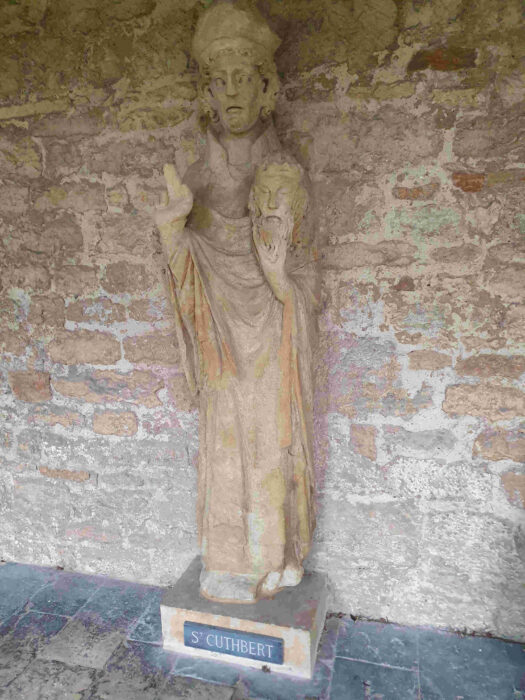
Bede describes the scene:
The skin had not decayed nor grown old, nor the sinews become dry; but the limbs lay at rest with all the appearance of life and were still moveable at the joints. His neck and knees were like those of a living man. Moreover none of his vestments and footwear which touched the flesh of his body was worn away. (p112)
News of this revelation spreads like wildfire. It’s a sure sign that Cuthbert is a saint! His cult rapidly extends through Britain and into Europe (we know of at least 38 surviving copies of Bede’s manuscript, 14 of which are in libraries in continental Europe: and there must have been many more at the time).
Churches are dedicated to him. People flock to his shrine. And there are reports of miracles and healing. His relics become highly sought after. They have saintly power …
Another Cuthbert saga begins
Then, in 875, another extraordinary chapter in the saga of Saint Cuthbert begins. His body goes on an epic journey.
The Vikings are coming. Their raids along the British coast are getting more frequent and more intense. The monks of Lindisfarne fear for their lives and the treasures of their Abbey. Above all, they are desperate to protect their most precious spiritual asset. Carefully, they lift Cuthbert’s coffin onto their shoulders and move it to a safer haven. First to a rocky hideout (what is now known as ‘Cuddy’s Cave’, which you can still visit). Then further inland.
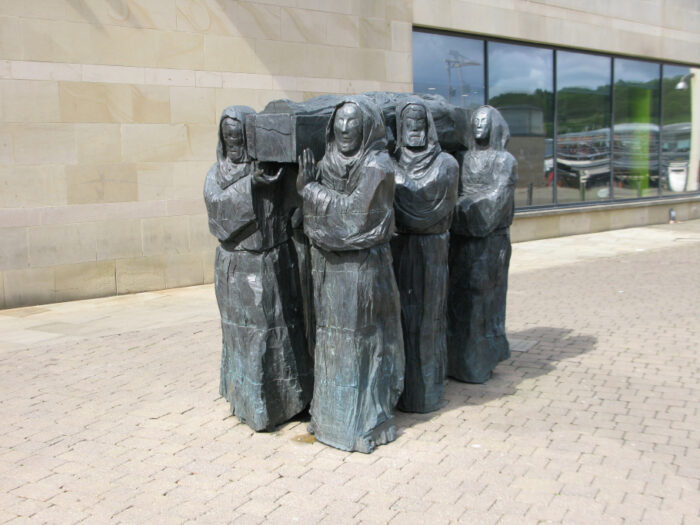
To east Scotland they travel. Then to west Scotland. Then to North Yorkshire. After seven years of wandering the coffin comes to rest at Chester-Le-Street, and there it lies for a century or more.
Finally the saint’s remains are taken to a clifftop plateau high above the river Wear, to Durham, where a new church is built to accommodate it.
Often, when I am walking in this area, leading groups on tours of North East England, I think of this ancient caravan threading its way through the rugged countryside, with the monks looking out anxiously to see if they can spy longships on the horizon. And always I pay homage to another Fenwick Lawson sculpture. It stands in Durham’s Millennium Square. It’s called simply ‘The Journey’. And it captures the anguish of this dramatic episode as brilliantly as Rodin captures the pain of the Burghers of Calais.
The Normans adopt, reluctantly, the legend of St Cuthbert
The next wave of invaders, the Normans, come from the south. They understand only too well the importance of relics, for William the Conqueror’s claim to the English throne is based on an oath sworn over holy bones. The Normans are also acutely aware of the danger of resistance from the tough peoples of the north. For a while they try to suppress the cult of Saint Cuthbert.
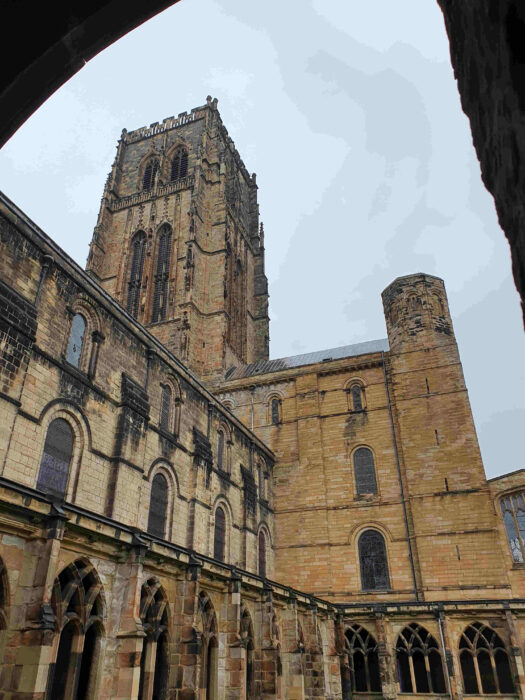
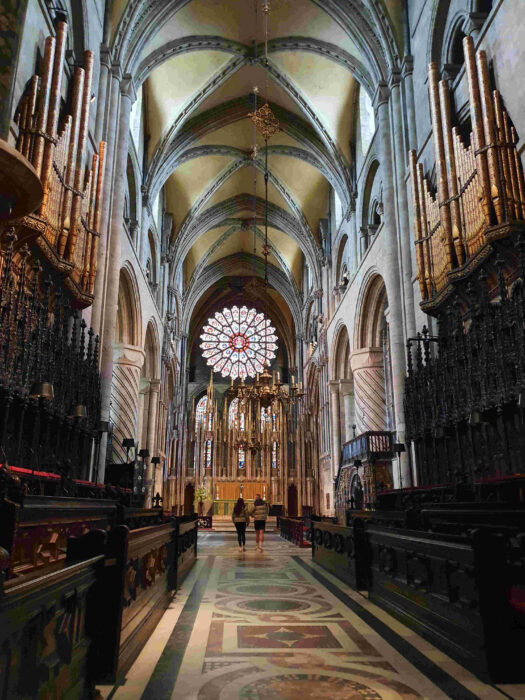
Eventually they are forced to acknowledge his power. So, instead, they try to annexe him for their cause. In fact, Cuthbert becomes central to the Norman strategy for imposing their chain-mail grip on this part of the country. They take his coffin, smash the original Saxon church which housed it and, in 1104, bury his body in pride of place, behind the high altar in their newly built Norman cathedral (not far from their newly built Norman castle).
And here, in Durham Cathedral, Cuthbert lies to this day. With glorious symmetry, his devoted biographer Bede is buried at the other end of the cathedral, the twin peaks of North Saxon Christianity. The flagstones around their graves have been polished and worn down by generations of supplicant knees. And there is still a palpable power and presence about them.
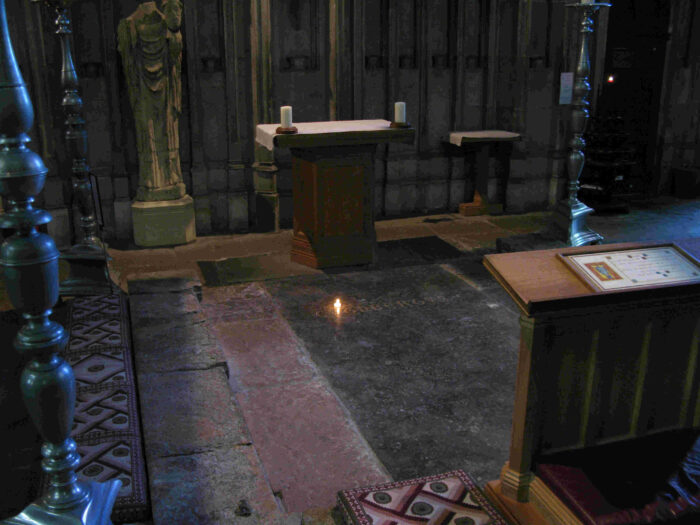
This is only part of the Cuthbert story, the first millennium. Right through the middle ages he continued to inspire the people of Northern England. His banner was carried into frequent battle against the Scots. His shrine was visited by Kings and commoners alike, until in 1542 it was destroyed by the commissioners of Henry VIII.
But still the fascination with Cuthbert persisted. Twice, during the Victorian period, his coffin was opened and his body examined, though by now it had finally turned to bones …
And so . … to the present day
Saint Cuthbert was in the news as recently as April 2012, when the book that originally accompanied him in his coffin was sold to the British Library for £9 million. It is possibly Europe’s oldest intact volume. A beautiful Gospel of St John, leather-bound, exquisitely inscribed. His favourite book of the Bible, known simply as the Cuthbert Gospel.
What would Cuthbert have made of all the fuss? Might he have been amused – or possibly bemused? Would he even recognize the world we have created nearly fifteen hundred years later?
Where he craved silence and solitude, we seem to fear and avoid them. Where he found deep solace in nature, we find ourselves out of tune with our environment. Where he saw a vision of St Aidan in the night sky, we struggle to peer beyond our cities’ light pollution …
How did we become so distracted, so materialistic, so out of touch? And how can we re-connect with a deeper sense of beauty and mystery?
Perhaps this is where places like Lindisfarne become so important. No amount of technology will change the simplicity of the sea, waves coming in and going out, the shoreline rising and falling with the tide, the Cuddy ducks taking off and settling ….
And nothing can erase the spirit of Saint Cuthbert, who speaks to us still across the rhythms of the island, all these lifetimes later.
Read Part 1 – Saint Cuthbert of Lindisfarne
© Tony Morris 2022.
More information
Tony Morris is an Oxford (UK) based writer, blogger and historian.
BBC Radio 3 podcast – Cuthbert of Lindisfarne
Durham Cathedral – resting place to this day of St Cuthbert’s shrine

It is a beautiful & inspirational story! Thank you for a deep insight into the subject.