

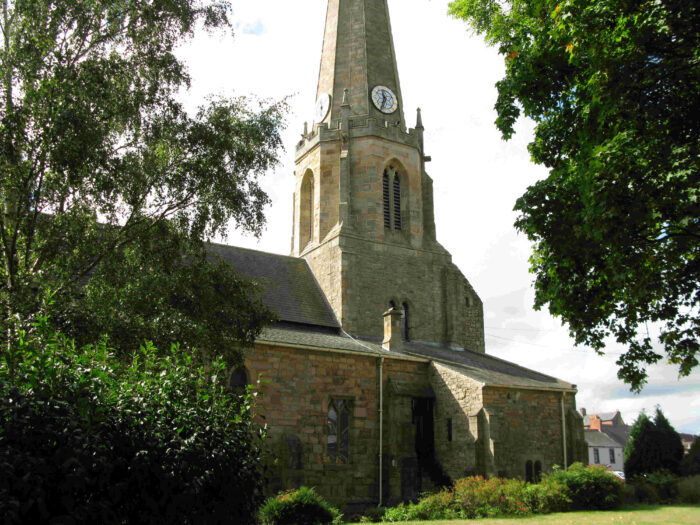
Most of the stories of St Cuthbert, the most important saint of Anglo-Saxon England, focus on his teachings on Lindisfarne, Northumbria, or the place of his final rest in Durham Cathedral. Yet for over a century, St Cuthbert’s remains were worshipped in Chester-le-Street, at the site of St Mary and St Cuthbert’s church.
Indeed, as the parishioners today like to remind visitors, between 882 and 995 AD their church, at first a humble wooden building on the grounds of an old Roman encampment, became perhaps the most important religious centre in northern England.
Church of St Mary and St Cuthbert – the leading cathedral in northern England
The monks of Lindisfarne, or Holy Island, had removed St Cuthbert’s body from the island in 882 AD because of the increasing frequency of Viking attacks on this part of the north-east coast, and fears that the tomb would be desecrated.
Already an influential religious community, the monks also took on a political role, supporting the Viking kingdom of York in return for the protection of their landed estates in the Tyne/Tees area. They helped to crown the (Danish) King Guthred of York, in return for which King Guthred granted the monks the site of the ancient Roman fort of Chester-le-Street (Cuneceastre), which straddled the old Roman road north to Newcastle and Hadrian’s Wall.
Their leader at the time, Bishop Eardulph, duly built a wooden shrine to the saint here, the location of the present church of St Mary and St Cuthbert. Eventually becoming the most important cathedral in northern England, St Cuthbert’s shrine was a place of pilgrimage for Kings and Queens from across Britain and Europe, as well as the more humble pious. The Saxon kings of Wessex, Athelstan and Edmund, were known to have visited, bringing with them gifts of gold, plate and precious books.
Nine successive bishops lead the community here in looking after the shrine, which also housed an early illustrated gospel, the Lindisfarne Gospels manuscript, produced at Lindisfarne in the 8th century in honour of St Cuthbert’s life. The position of the old wooden shrine was just to the east of the present church nave, as can be seen in the photo of the church plan.
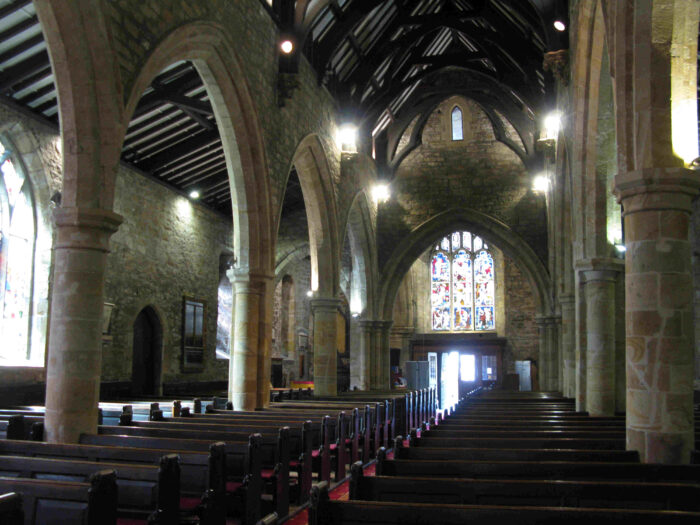

The church still has a facsimile copy of the original Lindisfarne Gospels manuscript, which was transferred to the British Museum in 1753. The copy is kept under lock and key to prevent damage, but can be viewed by arrangement.

St Cuthbert’s remains were finally removed from Chester-le-Street in 995 AD under the leadership of Bishop Aldhun, due it was claimed to ever-increasing Danish raids. From here they were taken south to Ripon in north Yorkshire.
The shrine, once gone, never returned
Yet the monks remained in Ripon for a few months only, the story goes, before they set out to return. On reaching Dunholme (or Durham) however, the coffin could not be moved any further. The legend is that the coffin refused to move, signifying God’s intention that the saint’s body should remain here.

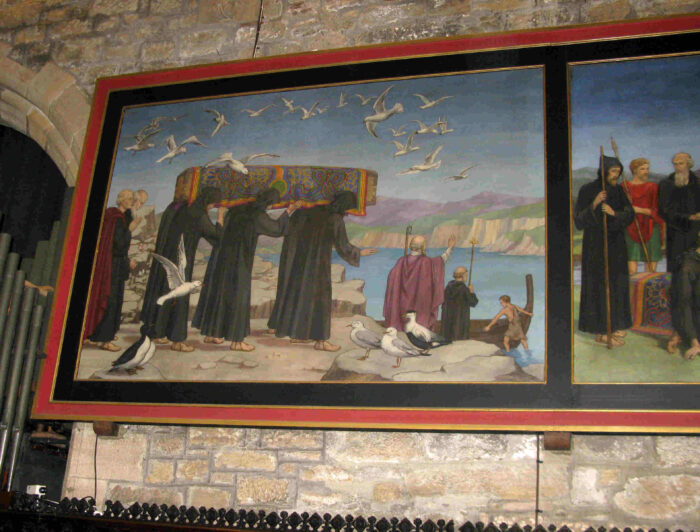
There is also a more secular explanation – it seems that Earl Uchtred of Northumberland had lost his ancestral fortress of Bamburgh to Viking raids (shades of Bernard Cornwell’s ‘Last Kingdom’ series of books), so decided to build anew on an easily defensible site at a loop in the river Wear. Earl Uchtred recognised the likely prestige of playing host to the saint’s remains, and so the settlement of Durham was built with a castle and a church to house St Cuthbert.
The shrine of St Cuthbert remained lost, then, to Chester-le-Street. In due course St Mary and St Cuthbert also lost its cathedral status, reverting to a simpler past. It remains however a rather lovely church, with a congregation that is proud of the building’s history. It also has perhaps one of the most active parish centres I have seen.
Chester-le-Street’s loss though is Durham’s gain. Here the saint’s body lies to this day, although the original Saxon church is long gone, replaced by a Norman structure. Durham Cathedral today is one of the most impressive religious buildings in the country, a suitably grand home for the patron saint of northern England.
© Philip Hunt 2022.
More information
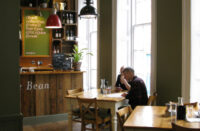
St Mary and St Cuthbert church in Chester-le-Street is open most mornings, depending on availability of church volunteers. The Parish Office across the street is welcoming, with an informative collection of books and pamphlets. It also has a small cafe run by friends of the church.
Saint Cuthbert of Lindisfarne – legendary holy man of Northumbria
St Cuthbert of Lindisfarne, Wikipedia
Church of St Mary and St Cuthbert, Chester-le-Street, Wikipedia
